
Maricopa County Directory Shelf
Historical directory work in Maricopa County starts with two linked collections. The Places We Lived collection on the Arizona Memory Project offers scans from the 1880s through the 1960s. Its broader genealogy guide reports nearly 400 digitized Arizona directories spanning 1881 through 1989. The State Research Library Arizona Collection holds added city and telephone directories in print, as well as yearbooks, biographies, periodicals, genealogy aids, and government reports. An empty digital result therefore does not show that a volume never existed.
| Directory group | Verified years | Keeper | Way to consult it |
|---|---|---|---|
| Phoenix resident books | 1898, 1899-1900, 1912-1919, 1921, selected later years | Arizona Memory Project | Free item scans online |
| Phoenix, Tempe and Mesa business directory | 1903 | Arizona Memory Project | Online collection browse |
| Phoenix telephone directories | 1927-1929 selected seasons | Arizona Memory Project | Digitized volumes |
| Arizona city and telephone directories | More cities and years than the online set | State Research Library | Reading Room appointment |
Coverage is not one unbroken annual run. The research verifies specific exposed editions, not every year or a final print date. Search the online browse by place and year, then ask the State Research Library to check its catalog and physical shelf. That two-channel method respects gaps without turning them into false claims about publication.
Maricopa County Directories Online
The digital shelf includes more than a list of Phoenix telephone subscribers. The collection description says typical volumes hold an alphabetical resident division, occupations, home addresses, street indexes, buildings, churches, societies, unions, services, and local advertisements. Agency, college, military, and organizational directories elsewhere in the Arizona Memory Project can supply a second route when a resident is absent from the main alphabetical run.
The collection page may be the fastest starting point, but item rights differ. A readable scan is not automatic permission to republish a whole volume. Record the item title, year, contributor, page, and stable item link. Those details make a later citation far more useful than a loose screenshot or an uncited transcription.
The Arizona State Archives genealogy collection shows the research route beyond the printed shelf:
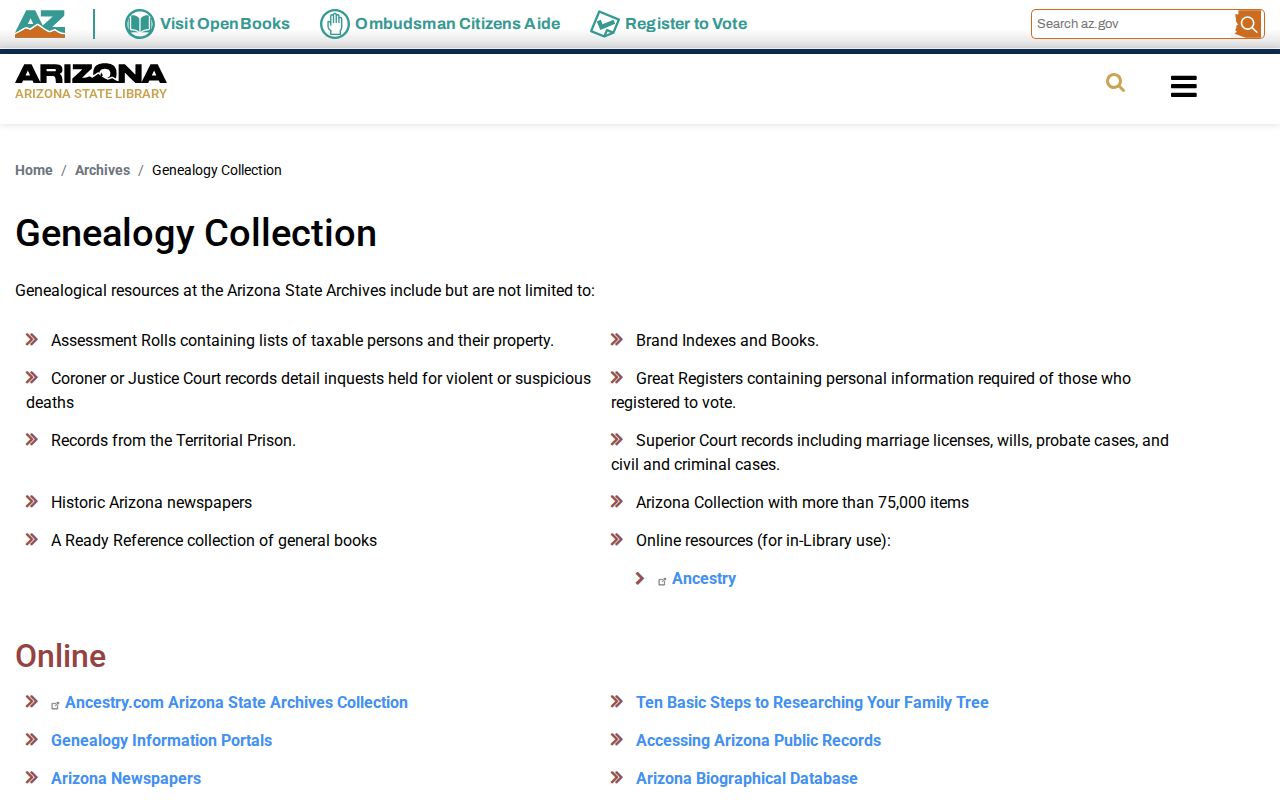
The archive channel matters when directory evidence points toward county marriage records, Superior Court material, manuscripts, or photographs rather than another printed volume.
Phoenix Directory Publishers Changed
Phoenix volumes should not all be labeled as one national publisher's work. The verified record begins with the 1898 Cox & Fleming Phoenix directory, while later named editions came from Arizona Directory Co., Phoenix Directory Company, and Mullin-Kille/Baldwin. Each change can bring a new geographic scope, layout, symbol set, or canvass method. Read the title page and legend anew instead of carrying rules from one edition into the next.
| 1898 | Cox & Fleming Phoenix City Directory, contributed by the Arizona Historical Society |
|---|---|
| 1912-1919 | Annual exposed Phoenix and Salt River Valley editions; 1914 also has a Phoenix and Maricopa County title |
| 1939 | Arizona Directory Co. Phoenix City Directory |
| 1946-1947 | Phoenix Directory Company edition |
| 1955 | Mullin-Kille/Baldwin Phoenix supplement with resident and street divisions |
The digitized 1898 Phoenix directory provides a clear early anchor:
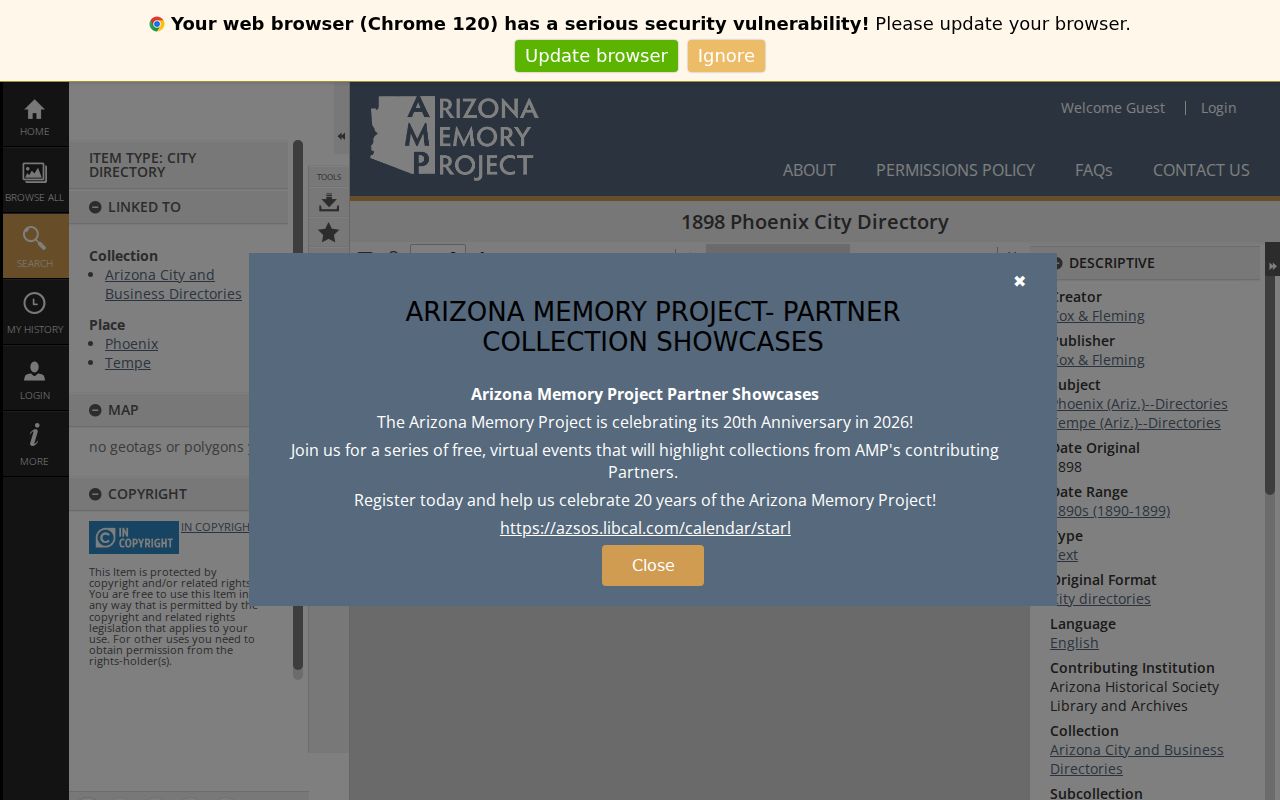
Its item record also identifies the contributing institution and digitization history, helping distinguish catalog facts from facts printed inside the directory itself.
Read Maricopa County Directory Entries
The 1955 Mullin-Kille legend offers the richest verified example. Trained enumerators made a house-to-house canvass and checked information supplied by employers, yet the publisher disclaimed errors. Its resident division may report the individual, a wife's name in parentheses, dependents under 18, home-ownership status, position, employer, home address, and an available telephone number. These fields are clues. They do not prove title or list every person in a home.
| Personal name | Identity as printed, often with initials that should be checked in nearby editions |
|---|---|
| Spouse and dependents | Family clues useful for separating people who share a name |
| Work line | Position and employer as gathered for that edition |
| Home line | Street address, ownership symbol, and available telephone number |
| Legend marks | Edition-specific symbols whose meaning must be read from the front matter |
- Criss-cross directory
- A section arranged by street or telephone number rather than by surname.
- Householders' directory
- The street-order division that places named householders along numbered addresses.
- Abbreviation key
- The volume's own list of shortened words and symbols. It controls how that edition should be read.
Reverse the 1955 Phoenix Directory
The 1955 volume has four divisions. Its buyers' guide covers local firms, professionals, churches, clubs, lodges, associations, schools, and nonprofits. A number-order telephone section follows. The Householders' Directory and Street Telephone Guide then orders householders by address, while the Resident/Cosmopolitan Telephone Directory returns to people by name. This structure allows movement in both directions: person to address, or address to a named householder.
Start an address search in the householder division. Note the listed resident, ownership mark, telephone number, and nearby addresses. Move to the alphabetical division to check spouse, dependents, position, and employer. Finally, compare the same street in the edition before or after it. A disappearance might mean a move, death, omission, or an unlisted entry, so no single cause should be assumed.
Key distinction. A canvassed householder entry is evidence for a point in time, not a county deed or a complete household roster.
Maricopa County Library Fallback
The State Research Library is the physical fallback when a Maricopa County historical volume is not online. It sits in the Polly Rosenbaum Archives and History Building at 1901 W. Madison Street in Phoenix. Arizona Collection material is viewed by appointment in the Reading Room, Monday through Friday, 8:30 a.m. to noon and 1 p.m. to 4:30 p.m., except holidays. The Arizona Memory Project lists 602-926-3870.
Send a focused inquiry before visiting. Give the municipality, target year range, surname or street, and the online volumes already checked. Ask whether the desired edition is in print and whether an appointment or advance pull is needed. Staff and catalogs can identify holdings, but an inquiry should not ask them to prove that two same-name entries are one person.
Yearbooks and organizational directories are useful companions. The Arizona Memory Project genealogy guide identifies school, college, military, agency, and other organizational material. No verified open modern alumni or congregation roster should be presumed public.
Trace Maricopa County Family Lines
A strong family trail moves across time in small steps. Published resident books bridge the long space between federal censuses, while the census can supply ages, relationships, and birthplaces that a directory omits. County deeds may test a home-owner mark, and an obituary or probate file may explain why a name vanishes. Keep the evidence from each source separate until two or more identifiers agree.
- Find the earliest likely alphabetical entry. Save the exact spelling, initials, spouse, work line, address, year, and page.
- Compare adjacent editions. Track moves, spouse changes, widow notation, and shifts in occupation without assuming every change is accurate.
- Use the street-order division to check the address and nearby households. This can separate two residents with the same name.
- Pair 1940 or 1950 directory evidence with the matching federal census. Compare household members and location.
- Test key transitions with a deed, marriage record, obituary, or probate docket. Cite each record on its own terms.
If the trail reaches the present, switch to the official one-person methods described on the Maricopa County resident lookup page. Modern indexes have different access rules and should not be treated like an old published directory.
Maricopa County Directories Meet Maps
Names gain context when they are paired with building and street evidence. The Library of Congress has Phoenix Sanborn fire-insurance sheets for 1889, 1890, 1893, 1901, and an updated 1915-1949 set. These maps can show a building footprint or use near a directory address. They do not identify every occupant. Later renaming and numbering also mean that a matching number is not enough by itself.
Phoenix changed fast. Official history places the city at 17.1 square miles and 106,000 people in 1950, compared with more than 500 square miles and more than 1.6 million today. That scale of growth makes year-appropriate geography vital. Match the directory year to a map from the same era, then compare the legal property trail if the location remains uncertain.
Note: Directory, census, map, and deed evidence answer different questions; agreement among them is stronger than any one source alone.
Before Maricopa County Directories
Maricopa County was created from Yavapai County in 1871, before the verified Phoenix city directory run begins. Phoenix's official history says the first county election took place that year. About twenty children attended school in the county-building courtroom, and an adobe school opened on Center Street, now Central Avenue, in 1873. The Salt River Valley Herald arrived as an early newspaper and became the Phoenix Herald in 1880.
This early record landscape explains why a directory-only search can fail. For a person who lived in the valley before the 1898 Cox & Fleming volume, turn to territorial government records, newspapers, manuscripts, photographs, church material, and later family evidence. The first verified directory in the research is not claimed as the first directory ever printed.