
Maricopa County Lookup Coverage
Choose the record by the claim that needs proof. A name alone is weak because Maricopa County has many same-name residents and each system indexes a different event. The Assessor names a parcel owner. The Recorder indexes parties to recorded instruments. Courts index parties and cases. The voter dashboard verifies information a known voter supplies. Historical vital images establish older life events, while current certificates have eligibility rules.
| Official record | Fact it can support | Search point | Access limit |
|---|---|---|---|
| Assessor parcel roll | Owner, situs, APN, subdivision | Maricopa County Assessor MCS | Free; ownership is not occupancy |
| Recorded documents | Grantor, grantee, instrument, title trail | Maricopa County Recorder | Name index; use legal identifiers |
| Court index | Party, case type, number, docket events | Local docket and state Public Access | Restricted case classes excluded |
| Voter verification | Registration and district details | Arizona Voter Dashboard | Known-person verification, not open browsing |
| Vital genealogy index | Older birth or death facts and image | AZDHS Genealogy | Noncertified; rolling time limits |
| Entity and license records | Filed role, credential, status | ACC or a state board | Affiliation does not prove residence |
Start with the source that best fits the known clue. If the clue is an address, use the parcel roll. If it is a lawsuit or probate matter, use the court index. If it is a company role, use the Corporation Commission. This keeps the resident lookup narrow and reduces false matches.
Match Maricopa County Lookup Names
Exact spelling is only the first pass. Search surname variants, Spanish compound surnames, initials, and a spouse name when the record itself provides those clues. Save stable identifiers such as an assessor parcel number, recording number, case number, license number, or entity ID. Then compare middle initials, dates, addresses, and the person's role in each record.
Require at least two independent matches before joining records to one person. A court party and a parcel owner with the same common name may be unrelated. An old address can be stronger when a matching middle initial, spouse, case date, or legal description supports it. Custodians can explain access and copies, but they generally will not research identity by phone.
Same-name rule. Treat every unmatched record as a lead, not a fact, until a second source supplies a stable point of agreement.
Search Maricopa County Resident Court Records
The Maricopa County Superior Court docket separates Civil, Criminal, Family, and Probate searches and includes calendars and minute entries. The criminal party search accepts last and first name. It also offers initials with date of birth, or a case number. Entries may change during an audit for up to 24 hours after posting. Only a clerk-stamped filing is official.
The local criminal name-search screen shows the limited fields used by this part of a Maricopa County resident lookup:
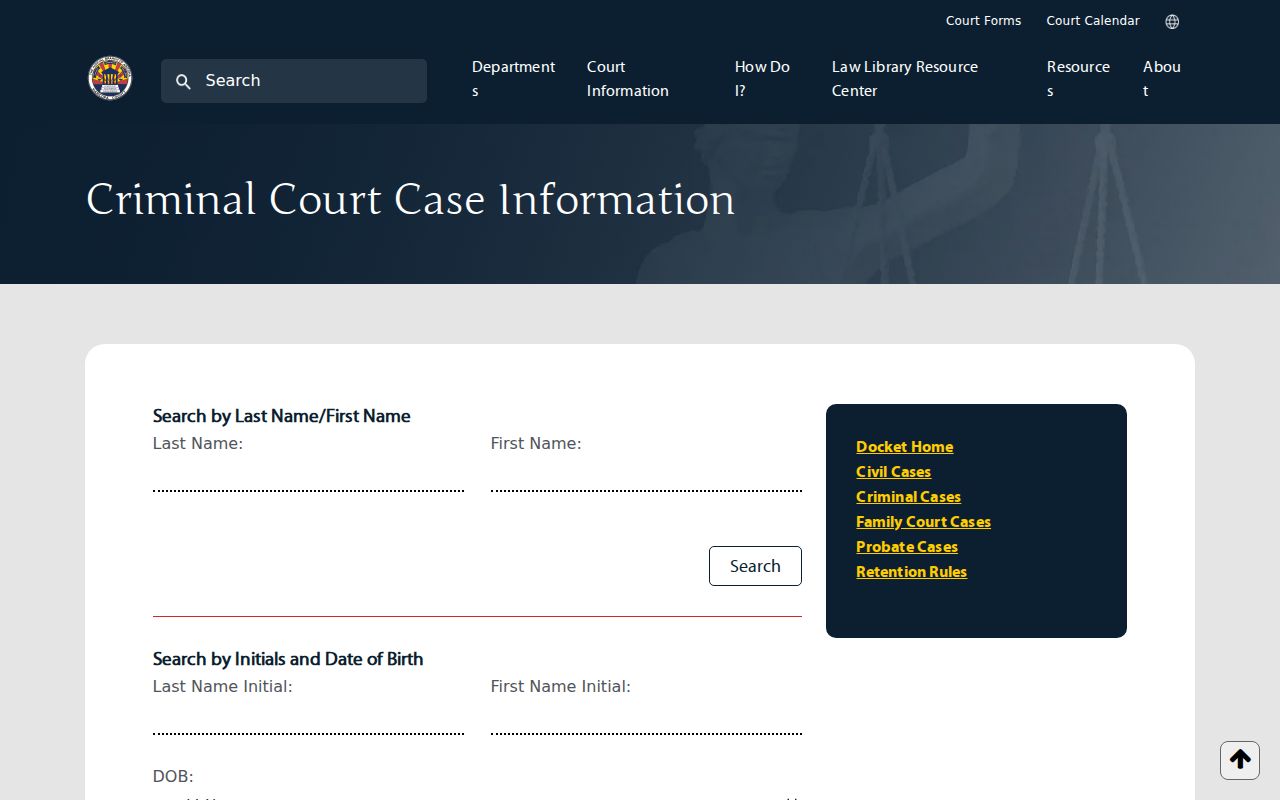
Use the case number from a plausible hit to follow the docket. Results can provide party names, case type, events, and minute entries, but sealed, juvenile, adoption, protection-order, and other restricted material will not appear. Clerk records and marriage-license copies are available at 601 W. Jackson Street in Phoenix, by calling 602-37-CLERK, Monday through Friday from 8 a.m. to 5 p.m.
| Party name | Last name and first name |
|---|---|
| Initials with date | Last initial, first initial, and date of birth |
| Direct case route | Case number |
| Result caution | Docket data is not the clerk-stamped official filing |
Compare Arizona Court Indexes
The statewide Arizona Public Access Case Lookup covers 177 of 184 courts. It is CAPTCHA-gated and refreshed each Friday with data through Wednesday. Maricopa Superior contributes only criminal cases there, and several local municipal or justice courts have partial limits. Use the county docket for the complete local route by case class, then use the state index to check cases that may sit in another Arizona court.
For eligible Superior Court civil and criminal documents filed since July 1, 2010, eAccess requires registration and payment. It supports full or partial case number or party name, an optional court choice, and advanced Boolean combinations. Sealed or restricted images stay out. The interface changed in April 2024, and old accounts were not migrated.
The eAccess portal illustrates the account-based document channel:
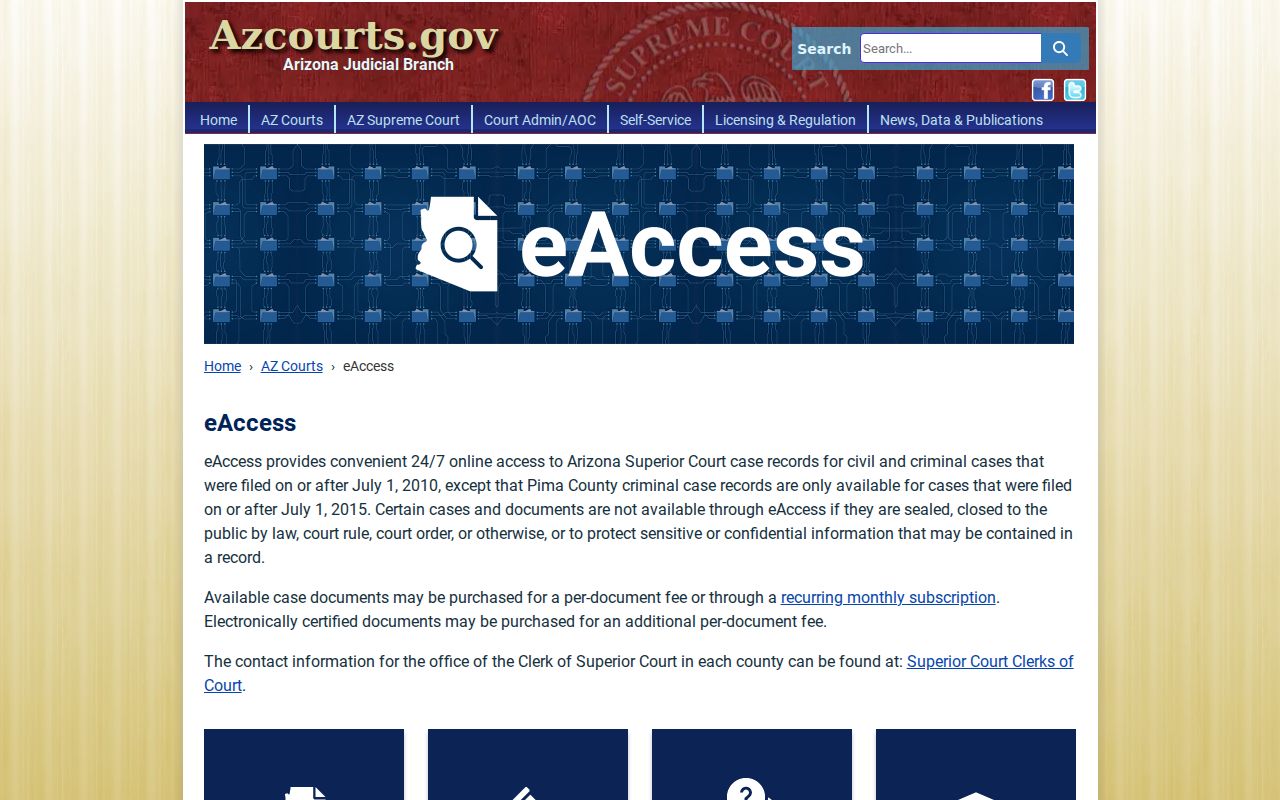
An index result may be free while an image or certified electronic copy costs money. Current exact eAccess prices were not verified, so check the live service before ordering.
Confirm Maricopa County Resident Life Events
The AZDHS Genealogy search publishes noncertified birth images after 75 years and death images after 50 years under A.R.S. § 36-351(B). The interface displays births from 1855 through 1945 and deaths from 1870 through 1970, even though the law creates rolling periods. Treat those endpoints as the current display, not the outer edge of legal eligibility.
The historical image search is a genealogy source, not an order for a certified record:
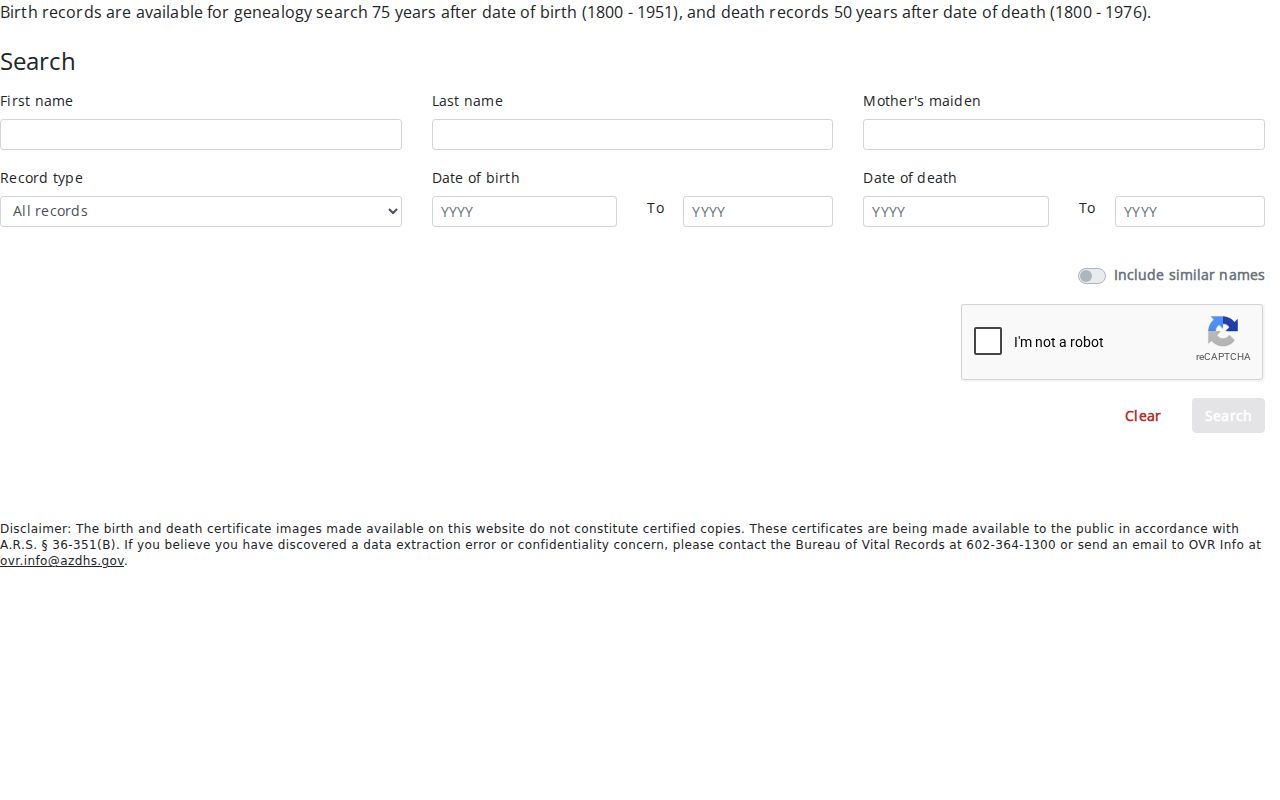
Current birth and death certified copies come from AZDHS or the Maricopa County local registrar and are limited to eligible applicants. The live state death application lists $20 per certified copy and $30 for a correction or amendment. Mail applicants provide signed photo identification or a notarized signature, proof of relationship, an original signature, and a stamped return envelope. Cash should not be mailed.
The Arizona vital records forms hub gathers eligibility rules and forms:
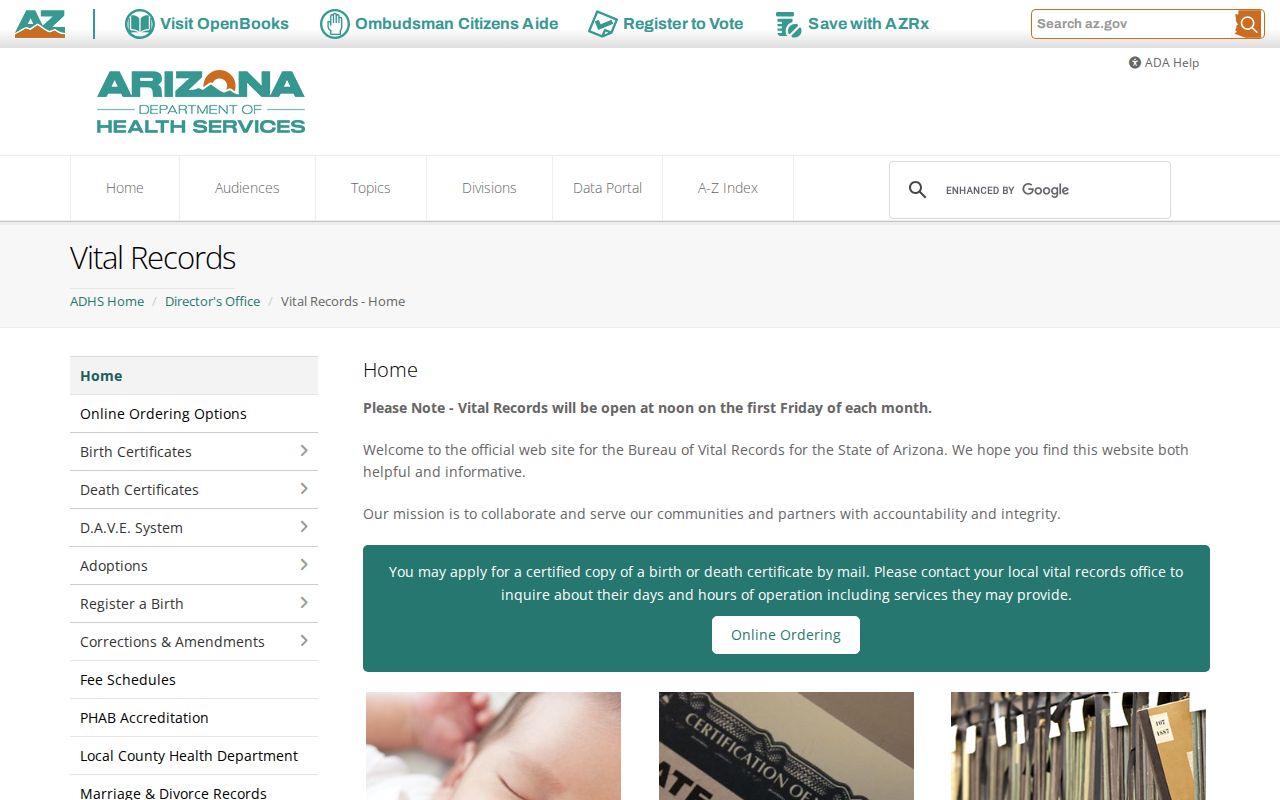
Marriage licenses and divorce files take a different path. Request them from the Maricopa County Clerk, not AZDHS. A divorce decree is a court file, not a state divorce certificate, and sensitive content may be restricted.
Check Maricopa County Resident Filed Roles
A business or professional clue can help distinguish residents, but it must be read narrowly. The Arizona Corporation Commission entity search accepts entity name, statutory agent name, principal name, or entity ID. Optional filters include entity type, status, name type, and county. A record may show the business name and ID, status, formation or approval, known place of business, agent, principals, and filed documents.
Arizona has no general statewide business license. Credentials are split among boards. The Arizona Medical Board, Board of Nursing, Registrar of Contractors, and Department of Real Estate each answer a specific status question. An agent address or professional affiliation is not proof that someone lives there.
Note: Use the entity or license ID as a match key, then verify any residence claim with a separate official record.
Verify Maricopa County Resident Records
The most reliable resident lookup turns one known clue into a chain of tested facts. The parcel roll is useful when an address or owner is known, while probate is the direct route for an heir question. A former classmate may appear in State Research Library yearbooks. An adoptee or birth parent must use Arizona's confidential adoption mechanisms because adoption files are confidential under A.R.S. § 8-121.
- Write the exact question and known identifiers. Include name variants, an approximate date, address, or record number.
- Choose the official index tied to that question. Save the case, parcel, recording, license, or entity identifier.
- Compare a second independent source. Match dates, middle initials, roles, and associated addresses rather than the name alone.
- Request the record image or a certified copy from its custodian when the legal document itself is needed.
- Send corrections to the office that owns the record: Assessor, Recorder, Clerk, AZDHS, ACC, or the relevant license board.
- Docket
- The running list of events and filings in a court case.
- Index versus image
- An index points to a record; an image shows the filed document or certificate itself.
- Certified copy
- A custodian-issued copy bearing formal proof that it matches the official record.
When Maricopa County Lookup Portals Stop
A failed portal search does not end the resident lookup. Ask the custodian for its counter, mail, or record-request route. Arizona Public Records Law, A.R.S. §§ 39-121 through 39-121.03, lets any person inspect public records during office hours and requires copies promptly, including by mail when a record is not posted online. Arizona sets no fixed response-day deadline. Inspection is free, and a noncommercial copy charge may not exceed reproduction cost.
Describe the record series, date range, name variants, and known identifiers. Ask to inspect first if the scope or cost is unclear. Judicial administrative records use the Superior Court's Rule 123 channel, while case files remain with the Clerk. The Recorder, AZDHS, ACC, and licensing boards each correct their own material.
The Arizona DPS route is different. DPS is not a public name-check service. A person may review and challenge only their own statewide criminal record through fingerprints. The personal Record Review Packet channel is shown here:
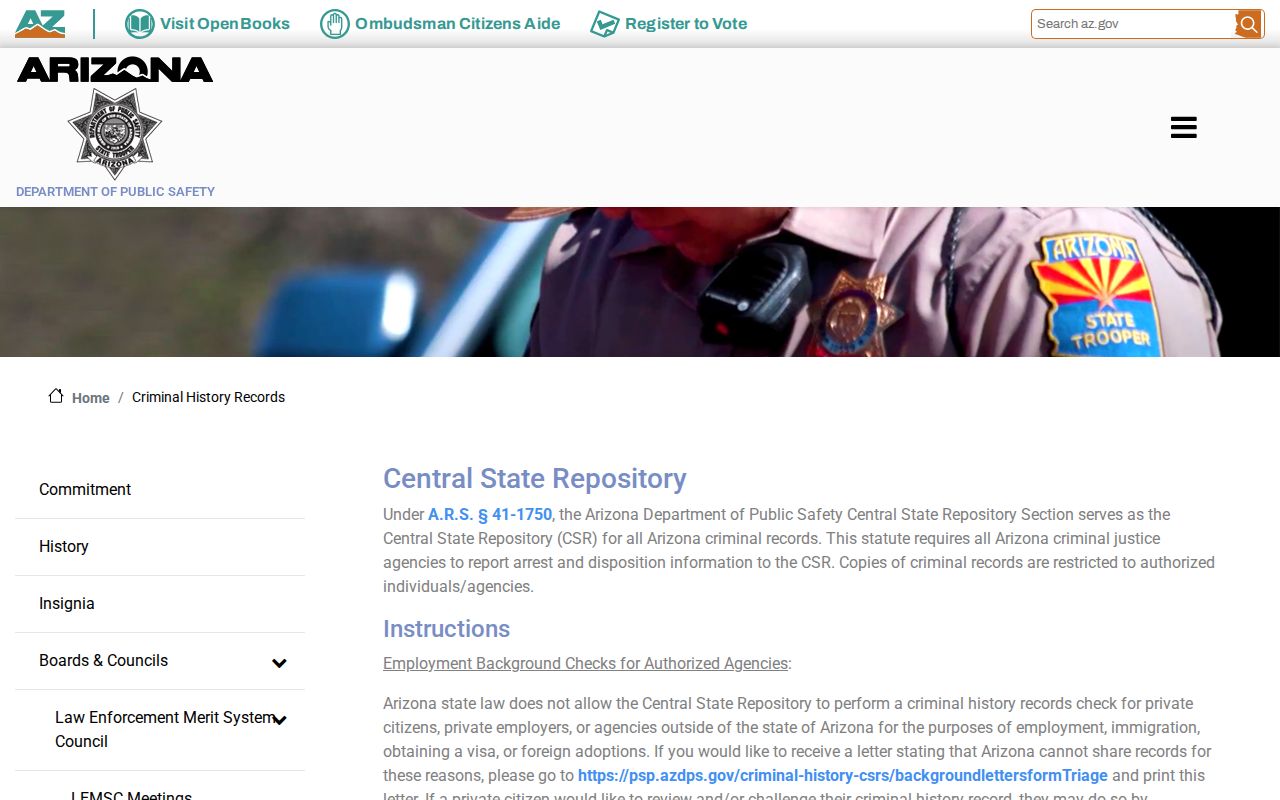
A complete packet response is mailed within 15 days. That self-review process must not be recast as a search for someone else.
Maricopa County Lookup Privacy Limits
The Arizona Voter Dashboard verifies a known voter using supplied identifying data. It is not an open browse-by-name household directory. Public voter files have uses limited by A.R.S. § 16-168, while A.R.S. § 16-153 removes a protected voter's residence, telephone number, and identifying number. Ballot participation never reveals ballot choices.
The Arizona Address Confidentiality Program gives eligible victims and household members a substitute address. Other state laws can restrict recorder, assessor, or identifying information for qualifying officials and public-safety roles. Sealed cases, juvenile files, adoption records, protection orders, motor-vehicle personal information, and current vital certificates also have firm boundaries. Never try to rebuild a protected address by combining other sources.
Lawful use. A Maricopa County resident lookup is for lawful personal research. Arizona law does not permit stalking, harassment, threats, or repeated unwanted contact.
Commercial compilation services may be stale or merge people who share a name. They are not official proof. Verify a material fact with the record custodian, honor confidentiality programs, and stop when contact is unwanted.